Backward Reasoning Game Solver
Solve sequential-move strategic games using backward induction. Use this skill when a user faces a multi-stage decision or negotiation where players alternate moves and each person's best action depends on what others will do later. Triggers include: user needs to determine the optimal opening move in a turn-based game or negotiation; user wants to know whether they can guarantee a win or favorable outcome before the game starts; user must sequence two risky actions and does not know which to attempt first; user is analyzing a multi-stage political, business, or competitive scenario where one party moves, the other responds, and so on; user has a finite-horizon sequential game with known player preferences and needs the game-theoretic solution; user suspects their opponent can anticipate their moves and wants to reason from end-states backward to their first action; user is building a game tree and needs to prune it to find dominant paths; user has a combinatorial takeaway game (like Nim variants) and wants the winning-position formula; user needs to understand why more flexibility or options can paradoxically hurt a player in a sequential game. This skill handles perfect-information, finite, sequential-move games. It does NOT cover simultaneous-move games (use a separate Nash equilibrium skill), incomplete-information games, or infinite-horizon repeated games.
 View on ClawhHub
Install
What You'll Need
Skill Relationships
Requires
No prerequisites. This is a foundation skill.
Source Book
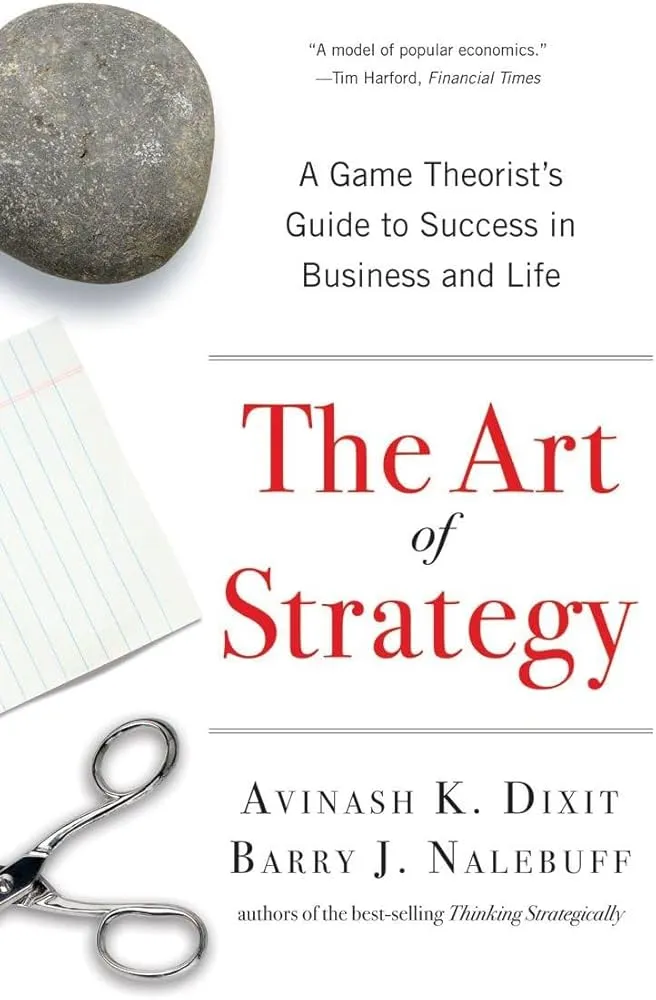
The Art of Strategy
Avinash K. Dixit & Barry J. Nalebuff